

You signed a contract with one company. On install day, there are four different logos in your building.
It happens constantly, and most people who sign these contracts have no idea it’s coming. The firm that walked you through the proposal turns out to be a layer of management sitting on top of two or three other companies who will do the actual work. Nobody told you, because nobody had to.
So it’s worth starting with the basics. Here’s what a systems integrator does, how one differs from the other companies you might hire for the same project, and the question almost nobody thinks to ask before signing.
What a systems integrator actually does
A systems integrator is the company responsible for making your building’s technology work as one system instead of several.
That’s the short version. In practice, a commercial building runs on a stack of separate systems that were never designed with each other in mind. The cabling infrastructure. The network. Security cameras. Access control on the doors. Phones. Conference room AV. Wireless coverage. Each one comes from a different manufacturer, each one has its own installation requirements, and each one has a vendor who will happily sell you their piece and walk away.
An integrator’s job is everything in between. Scoping what you actually need instead of what a manufacturer wants to sell. Designing systems that account for each other, so the cameras don’t overwhelm the network and the door controllers don’t fight the firewall. Installing it. Testing it as a whole. Then supporting it after everyone’s gone home.
The value isn’t in any single system. Any number of companies can hang a camera. The value is in the connections between systems, and in having one company that can’t blame another one when something doesn’t work.
The three kinds of systems integrator
The term gets used in three different industries that have almost nothing to do with each other, which is why searching it produces such a confusing set of results.
Industrial and manufacturing integrators work on factory floors. They connect production equipment, robotics, and control systems to business software. If you run a plant, this is who you need, and their world is entirely different from the other two.
Enterprise software integrators connect business applications. Your CRM to your ERP, your billing platform to your accounting system. This work is almost entirely software, usually delivered by consultants, and rarely involves anyone climbing a ladder.
Building systems integrators work on commercial properties. Cabling, networks, security, access control, AV, and the infrastructure that carries all of it. This is the one most businesses mean when they go looking, and it’s the one this article is about.
If you’re outfitting an office, a warehouse, a clinic, a school, or a retail space, the third category is your category. Knowing that saves you from three sales calls with companies who solve a different problem.
Systems integrator vs. everyone else you could hire
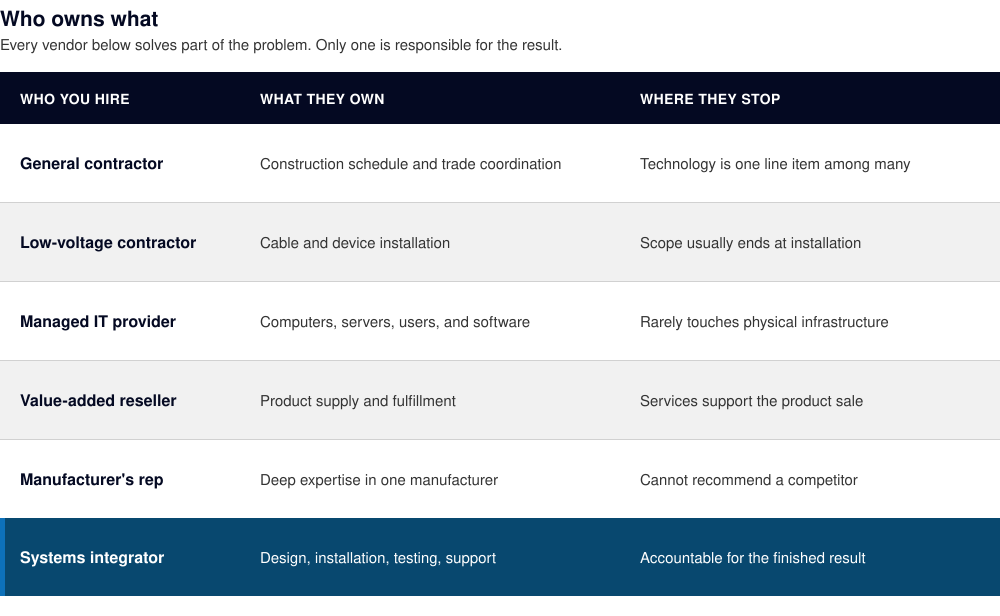
Several types of companies will bid on parts of the same project. They are not interchangeable, and the differences matter more after the install than during it.
A general contractor manages construction. On a build-out or tenant improvement, the GC coordinates the trades and keeps the schedule. Technology is usually one line item among dozens, and it’s frequently the line item that gets sequenced last. A good GC will bring in an integrator. A GC is not a substitute for one.
A low-voltage contractor installs cabling and devices. This is real, skilled work, and a crew that does structured cabling properly is worth a lot. But the scope typically ends at installation. Design decisions, system configuration, and long-term support are usually somebody else’s problem.
A managed IT provider handles your computers, servers, software, and users. Managed IT services are strong on the software and user side and generally stop at physical infrastructure. They’ll manage your network once it exists. They usually won’t design or install it.
A value-added reseller sells you products with some services attached. The business model is the product sale. Design and installation exist to support it, which shapes what gets recommended.
A manufacturer’s rep represents one brand. Useful for product expertise, and structurally incapable of telling you their product is the wrong fit.
An integrator overlaps with all of these and is defined by the part none of them own: responsibility for the finished result, across every system, after the last invoice.
Who’s actually doing the work?
Here’s where the industry gets uncomfortable, and where most buyers get surprised.
A large share of commercial technology work moves down a chain. The company that sold you the project subcontracts the cabling to another firm. That firm brings in a crew for the terminations. Someone else gets called for the door hardware. By the time anyone is standing in your ceiling, they may never have spoken to the person who scoped your job, and they have no relationship with you at all.
Nothing about this is illegal or unusual. It’s how a lot of firms scale — win the contract, assemble the labor, manage the margin. Some of them manage it well.
The trouble is what it does to accountability. Every handoff is a place where information gets lost and responsibility gets vague. The person who understood why the drops were placed where they were placed isn’t the person pulling the cable. The crew that ran the cable is gone before anyone tests the system end to end. Six months later, something stops working, and the honest answer to “whose problem is this” requires a phone tree.
You feel it in three places, all after the sale:
- During install, when a decision needs to be made and the crew on site doesn’t have the authority or the context to make it.
- At commissioning, when systems that were each installed correctly don’t work together, and each party can demonstrate their piece is fine.
- In year two, when you need warranty work and discover the warranty was between two other companies.
Bestegra doesn’t work that way. The crew running cable and installing devices works for Bestegra, which means the company that scoped your project is the company standing behind it.
Why the seams are where projects fail
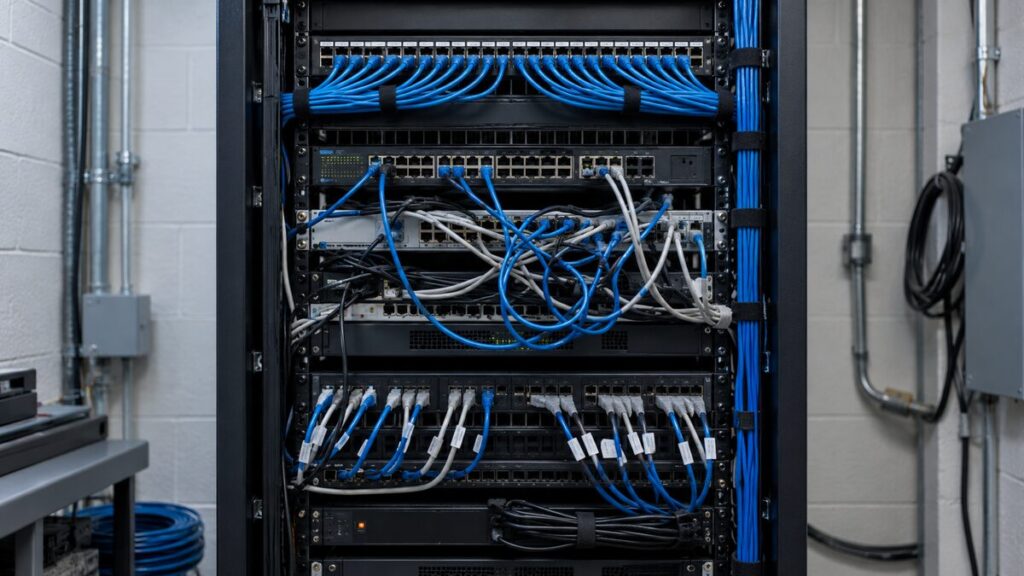
Almost nothing fails because a product was defective. Projects fail at the seams between systems, and seams are exactly what a chain of separate companies is worst at handling.
Some examples that show up over and over:
Cameras that swamp the network. The camera install is fine. The network was sized before anyone knew the camera count. Neither company did anything wrong, and video is unusable at peak hours.
Access control that works until it doesn’t. Access control systems land on the production network without anyone deciding whether they should. Then a network change locks people out of the building on a Monday morning.
Cable that meets spec and still causes problems. Certified terminations, correct materials, and device locations that fight the electrical plan or the ceiling grid, because the person placing them wasn’t in the design conversation.
Systems nobody commissioned as a whole. Every component tested individually, in isolation, and never once tested together the way it will actually be used.
Every one of these is a handoff failure. The fix isn’t better products. It’s fewer places for information to fall through, which is a structural question about who you hired, not a technical one.
Questions to ask before you sign
You don’t need to be technical to sort out who you’re dealing with. Ask these in the sales meeting and listen to how quickly the answers come.
- Will your company perform this work, or will part of it go to another firm? The most useful question on the list, and the one most rarely asked.
- If any part goes to another trade, who holds that contract — you or me? There are legitimate reasons a specialty trade gets involved. The question is whether managing it is your job or theirs.
- Will the person who scoped this project be involved in the installation? Continuity between design and execution is where most avoidable problems get avoided.
- Who commissions the system when it’s finished, and what does that testing cover? “We test everything” is not an answer. Ask what gets tested together.
- In eighteen months, who do I call, and whose warranty is it? If the warranty belongs to a subcontractor, you’re a step removed from the only party who can honor it.
- What happens if two systems don’t work together? Listen for whether anyone accepts responsibility for the space between systems, or whether each piece is guaranteed separately.
A vendor who answers these easily is telling you something real about how they’re organized. A vendor who gets vague is also telling you something.
What one company on the hook actually buys you
Single-point accountability sounds like a phrase from a brochure. What it means in practice is narrower and more useful.
It means one contract instead of coordinating several. It means the person who understood your building in the design phase is still connected to the project when decisions come up mid-install. It means when a system misbehaves, the diagnosis doesn’t start with figuring out whose fault it is. And it means the phone number you were given during the sale is the same number that works in year three.
None of that shows up on a line-item comparison. It shows up in the projects that finish on schedule and the ones that don’t, and in whether you spend the next two years managing your technology vendors or just using your technology.
If you’re planning a build-out, a move, or a security upgrade and you want a straight answer about what it takes, contact Bestegra and we’ll walk your scope with you.
Frequently asked questions
What’s the difference between a systems integrator and a general contractor? A general contractor manages the construction project as a whole and coordinates every trade. A systems integrator is responsible specifically for the technology systems, including their design, installation, and how they work together afterward. On most build-outs, both are involved, and the GC brings the integrator in.
Do I need a systems integrator for a single-system project? Not always. If you’re adding a handful of cameras to a system that already works, a straightforward install may be all you need. Integration matters when systems have to interact, when you’re installing more than one at a time, or when you’ll need someone accountable for the result long-term.
How much does a systems integrator cost? It varies too much for a useful number, because the work is scoped to the building rather than sold as a package. The larger point is that comparing bids on price alone is misleading, since bids often cover different amounts of design, testing, and post-installation support even when the equipment list looks similar.
Can a systems integrator work with the equipment I already have? Usually. Most commercial buildings run a mix of systems installed at different times, and a good portion of integration work is making existing equipment participate rather than replacing it. A wholesale replacement recommendation is worth a second opinion.