
The 2 a.m. Phone Call Nobody Wants to Make
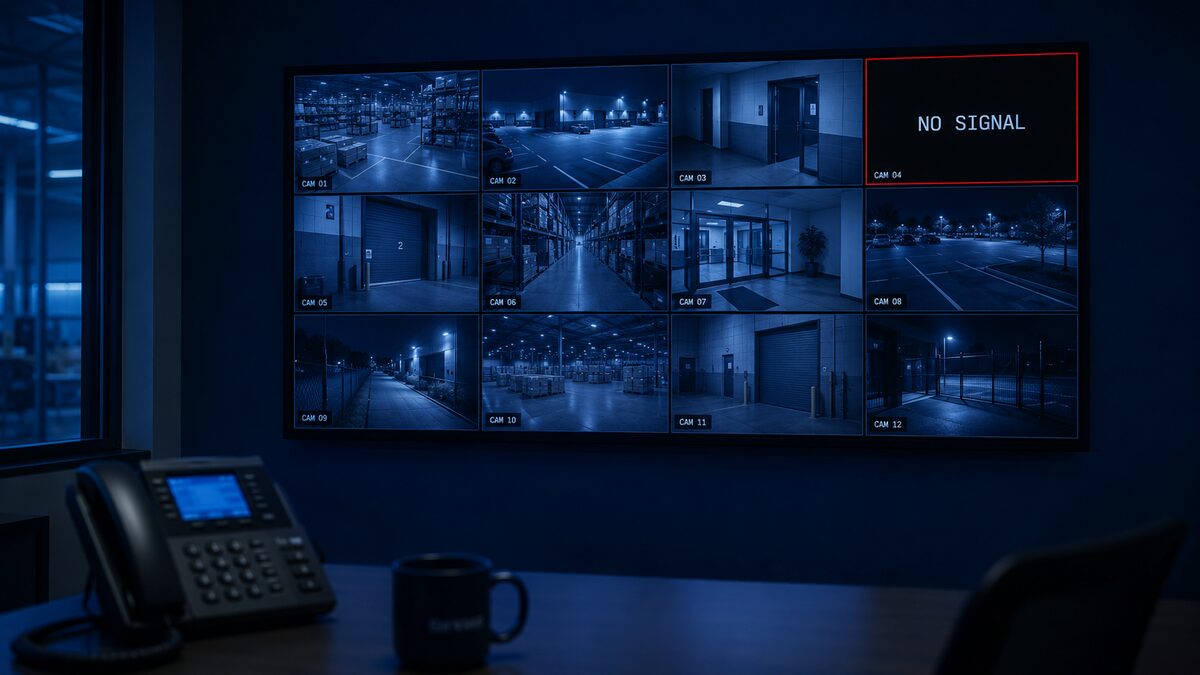
A camera goes dark at a distribution facility. The security integrator logs in remotely, checks the device, and says the hardware looks fine — it’s a network problem. The IT contractor checks the switch, says the connection is live — it’s a camera problem. Two vendors, two invoices, two service tickets, and nobody actually fixing anything until someone drives out and traces the cable by hand.
This is the scenario that plays out more often than it should, and it’s the reason a growing number of organizations are rethinking how they buy structured cabling. When the same structured cabling company that installed your network infrastructure also installed your cameras, access control panels, and intrusion sensors, that 2 a.m. call has one number to dial — not two, and not a coin flip about which vendor picks up the phone first.
You shouldn’t have to become a network engineer to figure out whose fault a dropped camera is. That’s the real argument for keeping cabling and security under one roof: it moves the technical back-and-forth behind the scenes, where it belongs, and leaves you with one relationship and one answer.
What a Structured Cabling Company Actually Does
If you’re not a technical person, “structured cabling” can sound like jargon for “running wires.” It’s more than that, and understanding the difference explains why it matters who does the work.
Structured cabling is the organized, documented, standards-based wiring system that carries everything in your building: your internet, your phones, your Wi-Fi access points, your security cameras, your door access readers, your fire and life safety devices. Think of it as the building’s nervous system. Every smart device you add over the next decade will depend on it.
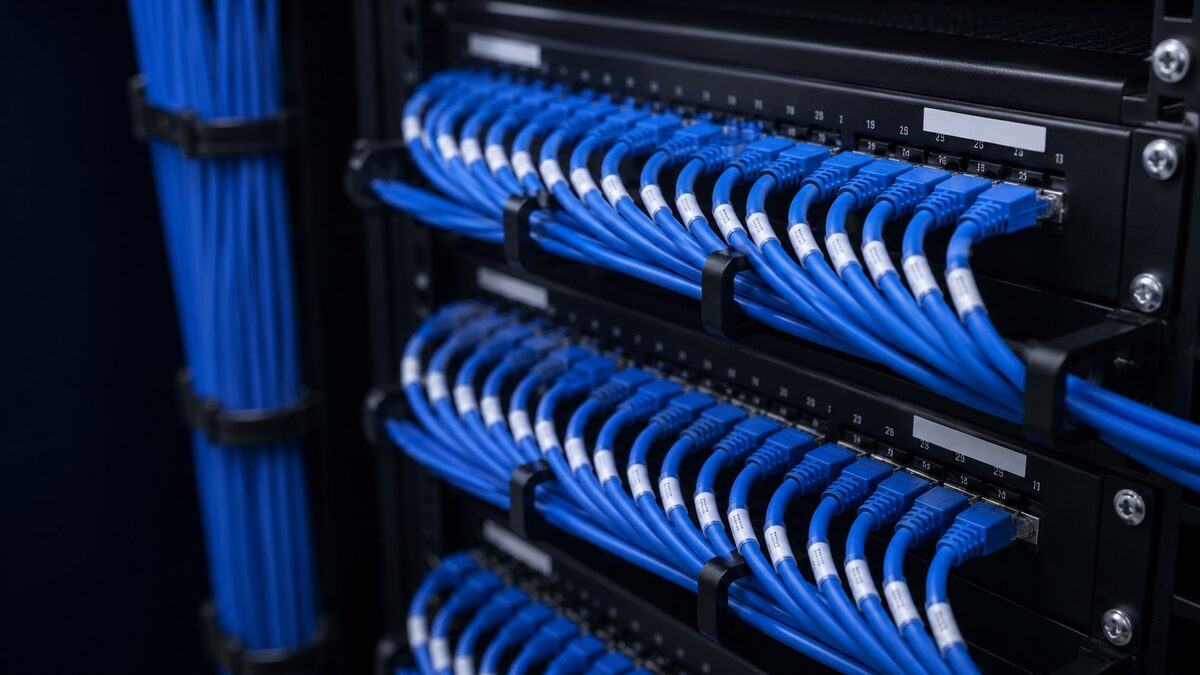
The “structured” part is the point. A structured cabling company doesn’t just pull a cable from point A to point B — it designs the whole system so that cables are organized, labeled, tested, documented, and built with room to grow. When it’s done right, you never think about it. When it’s done piecemeal by whoever happened to be on site that year, you inherit a tangle behind the walls that nobody fully understands — and every future project starts with someone trying to reverse-engineer it.
Here’s the part most organizations miss: your security system is a network system. Modern cameras, access control, and intrusion detection are all devices that live on your cabling and network. Which means the health of your security system is only as good as the infrastructure underneath it — and the vendor relationships around it. It’s why physical security solutions that arrive separately from the cabling so often turn into two projects that don’t quite meet.
Where the Split-Vendor Model Breaks Down
Most commercial buildings didn’t end up with fragmented infrastructure on purpose. It happened one project at a time: an IT contractor ran data cabling for the office network years ago, then a security vendor showed up later to add cameras and card readers, running their own cable on their own schedule, documented in their own way — if it was documented at all.
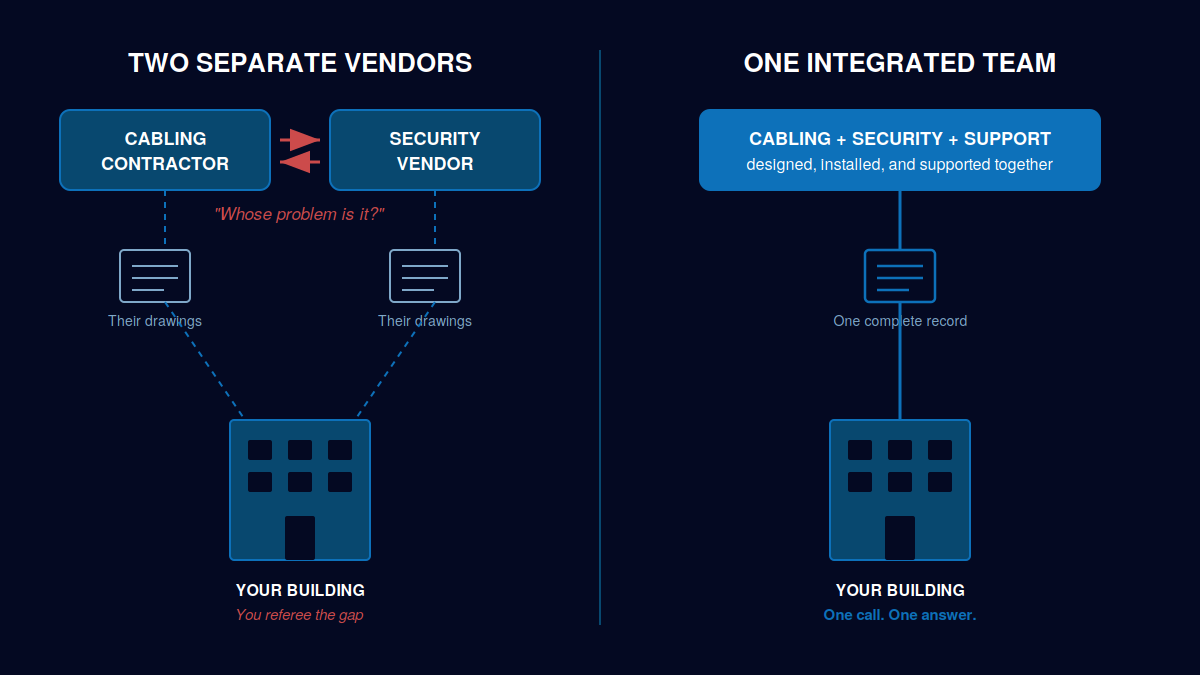
The result is a building with two (or three, or four) sets of cabling, two sets of drawings that may or may not agree with each other, and two vendors who have never spoken to each other and have no contractual reason to. Everything works fine until something breaks at the boundary between systems — and that boundary is exactly where security cameras and access control live.
A few of the failure points this creates:
- Ambiguous ownership when something fails. Is a dropped camera feed a cabling problem, a network problem, or a camera problem? Each vendor has an incentive to say it’s the other one’s issue — and you’re the one paying while they sort it out.
- Duplicate site visits and duplicate invoices. Two truck rolls to diagnose one outage, billed by two different companies, neither of whom is responsible for the whole picture.
- Cabling and equipment that were never planned together. The network needs to be sized to handle everything running on it — discovering it can’t during installation is a delay and a change order, not a technical footnote.
- No single record of what’s in your building. When the cabling company and the security integrator are different vendors, there’s rarely one accurate drawing set showing where every cable actually runs. That makes every future change slower and more expensive.
- Warranty and support gaps. When systems from different vendors interact and something fails, warranty coverage can turn into a negotiation about whose scope the failure falls under.
None of these problems show up in the proposals. They show up eighteen months later, at 2 a.m., when the camera covering your loading dock goes dark.
What Changes When Your Structured Cabling Company Also Owns Security
An integrated approach means the same team plans the cable pathways, installs the cabling, and installs the cameras, access control readers, and sensors that depend on it. That’s a structural difference, not just a convenience.
One team designs for the whole system up front. Camera placement, door hardware, and network capacity get planned together, so the infrastructure that goes in supports what’s actually being installed on top of it — not a rough guess at what a future vendor might need.
One set of documentation. Drawings, cable labeling, and equipment records reflect the entire system, not just one vendor’s slice of it. When something needs to be traced six months or six years later, there’s one accurate record to pull.
One point of accountability when something goes wrong. A dropped camera, a slow door reader, a network hiccup — it gets diagnosed and fixed by the same team that installed the whole path, end to end. There’s no vendor boundary for the problem to hide behind, and no finger-pointing for you to referee.
Fewer surprises during changes and expansions. Adding a camera, moving a reader, or expanding into a new suite doesn’t require reconciling two vendors’ assumptions about what’s already in the walls.
One relationship to manage. For the executive or facility manager responsible for all of this, the practical difference is a single contact who understands the whole system — instead of a vendor directory and a mental map of who owns what.
What This Looks Like on a Real Project
For an organization adding security infrastructure to an existing building, an integrated structured cabling and security project typically means:
- We look before we build. A walkthrough of your building maps what’s already in the walls and what capacity it has, so nothing gets designed in a vacuum.
- We plan for where you’re headed, not just where you are today. Cable and network capacity get sized for the cameras and access points you’re adding now, and the ones you’ll likely want in a year or two — so “we’re out of room” isn’t a surprise at your next expansion.
- We install it to last, not just to work today. The cable, the connections, the testing — all of it is done to hold up over years of use, not just pass inspection on day one.
- One team installs the cameras, doors, and sensors on infrastructure they already understand completely, because they’re the ones who put it there.
- You get one clean record of what’s in your building — not a filing cabinet of drawings from different vendors that may or may not agree with each other.
None of this requires you to know a switch port from a patch panel. It requires the people doing the work to be accountable for the whole system, not just their piece of it.
The Systems That Ride on Your Cabling
Structured cabling is the foundation, but it’s rarely the reason a project starts. Projects start because an organization needs something the cabling makes possible. All of these run on — and depend on — the same infrastructure:
- Video surveillance — cameras, recording, and monitoring for facilities, parking, and entry points
- Access control — card readers, door hardware, and the management systems that decide who gets in where, and when
- Intrusion detection — sensors and alarms tied into monitoring and response
- Fire alarm and mass notification — life safety systems with their own code requirements, tightly connected to the rest of the building’s infrastructure
- Networking and Wi-Fi — the connectivity every one of the above depends on
- A/V and communication systems — conference rooms, paging, and displays that share the same pathways
When one integrator handles all of it, these aren’t six separate projects with six separate vendors. They’re one coordinated system — designed together, installed together, and supported together.
When It Makes Sense to Consolidate
You don’t need to rip anything out to move toward a single-vendor model. The natural moments to consolidate are the ones where work is happening anyway:
- New construction or a build-out — the single best opportunity to get cabling and security designed as one system from day one
- An office move or expansion — new space means new infrastructure; it’s the cheapest time to do it right
- A security upgrade — replacing aging cameras or access control is the moment to evaluate whether the infrastructure underneath can support what’s next
- Vendor frustration — if you’re already fielding finger-pointing between your cabling contractor and your security vendor, the problem won’t fix itself; each new device makes the boundary messier
If none of those apply yet, the practical move is simpler: the next time either vendor is due for a renewal or a project, ask the questions below and compare the answers to what a single integrator would tell you.
Questions Worth Asking Before You Split the Work
If your organization is planning a security upgrade, a new build-out, or an expansion into new space, it’s worth asking any vendor directly:
- Will the same team that runs our cabling also install and support our cameras and access control?
- If a device fails, who do we call — and how do they determine whether it’s a cabling, network, or device issue?
- Will we get one complete document set for what’s in our building, or will cabling and security records live with two different companies?
- Who is responsible for making sure our infrastructure can handle the devices we add over time?
- Who do you actually send to our site — your own technicians, or subcontractors we’ve never met?
If the honest answer involves two separate vendors and a “we’ll coordinate with them” promise, weigh that against the cost of consolidating the work with a single integrator from the start.
Frequently Asked Questions
What does a structured cabling company do?
A structured cabling company designs, installs, tests, and documents the organized wiring system that carries a building’s network, phone, Wi-Fi, security, and life safety systems. Done properly, it includes planning for future growth, labeling and documentation, and testing to industry standards — not just running cable from one point to another.
Can our existing cabling support new security cameras?
Often, yes — but it depends on the age, quality, and capacity of what’s in your walls. A site assessment answers this before anything is purchased. Sometimes existing cabling supports new cameras with no changes; sometimes select runs need upgrading. A good integrator tells you which, and only replaces what actually needs replacing.
Do we have to replace everything to consolidate under one vendor?
No. Consolidation usually happens gradually, at natural moments — a security upgrade, an expansion, a move, or a vendor renewal. A single integrator can take over support of existing systems, document what’s there, and improve the infrastructure over time as projects come up, rather than requiring a rip-and-replace.
What’s the difference between structured cabling and just running cable?
Running cable gets a device connected. Structured cabling is a designed system: organized pathways, consistent labeling, testing to standards, documentation of what’s installed where, and capacity planned for future needs. The difference shows up years later — in how quickly problems get diagnosed and how easily the building supports new technology.
Who supports the system after installation?
With an integrated provider, the same organization that designed and installed the infrastructure supports it — including the cameras, access control, and other systems running on it. That continuity matters: the people troubleshooting a problem already know exactly what’s in your building, because they put it there and documented it.
How much does structured cabling cost?
It depends on the size of the building, the number of connection points, the condition of existing infrastructure, and the systems running on it. What matters more than the per-drop price is total cost over time — poorly planned cabling generates repeat service calls, redundant installs, and expensive surprises during every future project. A site assessment produces a real number for your building.
The Bottom Line
Structured cabling isn’t a separate purchase from your security system — it’s the foundation the whole system runs on. Treating it as two unrelated vendor relationships is how organizations end up with dropped cameras, finger-pointing between contractors, and documentation nobody trusts.
Bestegra plans, installs, and supports structured cabling and the security and life safety systems that depend on it as one integrated scope, with one team accountable for how the whole thing performs — not just the piece they happened to install. And because the procurement experience should be nontechnical, you tell us the results you need; we handle the technical work of getting there.
Talk to Bestegra about an integrated security and cabling project
Table of contents
- The 2 a.m. Phone Call Nobody Wants to Make
- What a Structured Cabling Company Actually Does
- Where the Split-Vendor Model Breaks Down
- What Changes When Your Structured Cabling Company Also Owns Security
- What This Looks Like on a Real Project
- The Systems That Ride on Your Cabling
- When It Makes Sense to Consolidate
- Questions Worth Asking Before You Split the Work
- Frequently Asked Questions
- What does a structured cabling company do?
- Can our existing cabling support new security cameras?
- Do we have to replace everything to consolidate under one vendor?
- What’s the difference between structured cabling and just running cable?
- Who supports the system after installation?
- How much does structured cabling cost?
- The Bottom Line